c h r o n o l o g i c a l
g u i d e
> Year 1 Year 2 <
> Year 3 Year 4 <
> Year 5 Year 6 <
> Year 7 Year 8 <
> Year 9 Year 12 <
fetching & dismantling
sandblasting & evil rust
right "b" pillar
fixing right inner sill
basic body repair, por-15
frame removed, footwell repair
hole fixed, car flipped, etc.
sill stiffeners, rear bulkhead, etc.
various small parts
left sill, added stiffener, etc.
- lousy weather
trunk floor (reprise)
right floor, left sill, etc.
left floor, wheel well, etc.
right upper wishbone
floor done, car righted
rack, front frame, evil rust
left door cleaned & fitted
right door, right suspension
bonnet, part 1
bonnet, part 2
bonnet, part 3
bonnet, part 4
bonnet, part 5, etc.
bonnet, part 6
bonnet, outer sill, etc.
lots of stuff
left side, bonnet internals
frame, bonnet attached
engine stand, oil pan removal
pistons removed, sanding
sanding, final filling
color, frames, primer
brushed primer test
2nd coat primer
holiday greetings!
finish prep, details on dent fix
spraying primer
winter chores
1. undercoat, plating prep
2. plating, spraying color
bonnet, plate prep, cylinder head
cylinder head paint, bushes
plating saga
front frame, suspension, part 1
front suspension, part 2
front suspension, part 3
priming and painting
bonnet, part 7
painting color!
boot lid, steering wheel
gas tank
winter chores
1. firewall sundry
2. front suspension
3. steering setup
4. master cylinders/pedals
5. the rest
data plate screed
winter to spring
1. irs rebuild
2. trunk floor, harness
3. data plate (again)
data plate, door, headlights
dash vinyl, crosshatch aluminum
windshield, right door
interior, "widget"
chrome parts!
door handle details
rolling chassis
molasses rust removal
electrical, part 1
bores, thrust washers
new engine!
head differences
block differences
compression ratio
engine in place!
alternator
catchup & photos
it runs!
setback and brakes
darned close & engine diffs
driven
top and seats
driving and little stuff
|
|
|
Primer, Sanding, Finish Prep
Patience is a virtue, I keep telling myself. If that is the case, I expect that people who do block-sanding and priming for a living are among the saints of the world.
 At least they are among the most virtuous, since it seems you can't rush priming and blocking.
The weather over the holidays here in North Carolina has been uncharacteristically warm, with temperatures reaching into the 60s (Fahrenheit, or about 15 Celsius). The
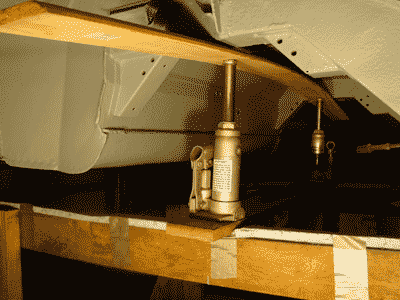 garage has been nice and warm, and I have been able to do some more priming in shirt sleeves. As a result, the entire exterior and the body shell underside is primed.
(Actually, there are small portions of the underside that need some primer — the front portion of the footwells that sit on the crude frame I made to hold the
body.) On New Year's Day 2003, we had just finished sealing the truck floor, and the car was still inverted. So, there has been progress.
garage has been nice and warm, and I have been able to do some more priming in shirt sleeves. As a result, the entire exterior and the body shell underside is primed.
(Actually, there are small portions of the underside that need some primer — the front portion of the footwells that sit on the crude frame I made to hold the
body.) On New Year's Day 2003, we had just finished sealing the truck floor, and the car was still inverted. So, there has been progress.
The trunk floor was again something that needed some attention. When we put the car body on the rolling rack, we placed it on two two-by-four beams cushioned
with styrofoam insulation. The body rests on the footwells and on sides of the trunk floor. In order to prime the parts of the trunk floor that were obscured by this
set up, I first primed the housing for the IRS, let the primer dry, and then jacked up the trunk from the beams using some spare wood and two hydraulic jacks that
float around the garage and elsewhere. (They've been wonderfully serviceable little jacks in their long history around here, jacking up old floors, a mud-bound horse
trailer [twice!], and trucks in assorted situations.)
 Anyway, the jacking opened up most of the space along the beams and all of the trunk floor for priming. As I mentioned, only the front footwells still need priming. So,
after I'm done with the trunk floor, I'll get those primed. I figure that I'll get the "Rock Schutz" rocker guard on the edge of the trunk before I lower it, though.
Anyway, the jacking opened up most of the space along the beams and all of the trunk floor for priming. As I mentioned, only the front footwells still need priming. So,
after I'm done with the trunk floor, I'll get those primed. I figure that I'll get the "Rock Schutz" rocker guard on the edge of the trunk before I lower it, though.
All of these theatrics with the jacks could have been avoided, I know, if I had built or invested in an honest-to-goodness car "rotisserie." Live and learn. If I ever
restore another Jag, I'll know better.
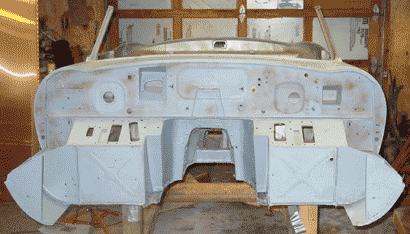
The front bulkhead (or firewall) is now completely assembled and ready for a final sprayed coat of primer and then some color. The picture shows the area partially blocked,
since you can still see areas with the marker coat of spray paint. I put the marker coat on quite lightly. The footwell parts of the bulkhead came out quite well. I had to
repair both of them last November. Check out the pictures of the footwell repairs and the front bulkhead as it was being dismantled. Since the bulkhead
has many curved indentations and smaller flat areas, I had to abandon the block for the most part. Even my four-incher wouldn't work very well in the constrained space. I'm
not too worried about the smoothness of the finish on the bulkhead. I have concentrated on areas that are less obscured by parts either affixed to the bulkhead or by hoses
and such. This section of the car body will just get a once over with sanding. I'll do a spray of primer on the surface, followed by color.
The plan for spraying color is a little clearer to me now. I'm now planning on spraying color on the underside of the car and the front bulkhead first, perhaps with the
interior and inside the trunk, too. My main interest is getting the body to a point where I can begin to reassemble sections like the independent rear suspension and the front
end. It also seems prudent to hold off on spraying color on any exterior section until all the exterior is ready to accept color — including the bonnet.
That bonnet is now in a corner of the garage. When I need to clean excess primer off a brush, I smear it on the bonnet. That's all I'm willing to do on the bonnet at this
point. It can wait until I have a rolling body.
|
|
Detail Body Repair
The right door has required a lot of work, and I ran into a troublesome high spot that needed some hammer work and some additional body filler to
remove a dip. The location is right in the vicinity of the "A" post, and it looks like one of those unfortunate dings that comes from a tree branch
or something dropped.
It seems a good occasion to go through the whole process of fixing the small ding at this stage in the priming and blocking process.
Detecting the dent — Why light is your friend
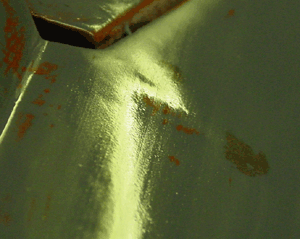
Although this dent was big enough to notice with the fingertips and from sand-through and left over "guide" spray paint, it's good to see why light
is your friend. The top photograph shows the "light line" that falls over the problem area. Of course, I didn't need to see the line to see (or, rather, feel)
the problem, but the line illustrates what happens when light hits a bump. You can set up a flourescent light to serve as a light source, but this often
isn't necessary. Most of the reflection comes from lights on my garage ceiling. For areas that are "below the curve" and therefore where I can't use
ceiling lights, I use a pair of halogen lights on a stand. I picked them up at the lumber yard for about $25 (USD) — a pair of 1000 watt halogens
have come in handy.
Anyway, look for an interruption in the light line. You can usually get the feel for where the line ought to go with practice. If you are in doubt, use the
vehicle's symmetry to your advantage. Take a look at the light line on the corresponding section on the other side of the car.
It's said that Sir William Lyons wanted to see an example of a pre-production car sprayed in black gloss so that he could look at the "light lines"
of the design. In a sense, that's what you do as you take in the light lines while block-sanding the primer. You look for the consistencies, or, rather,
you look for the inconsistent in order to find the problems.
Hammer work and surface prep
Lots of times block-sanding an area will show you where the bumps and the dents are located. The dents or impressions keep the color of the guide coat that you
lightly spray over the primed surface before blocking. They keep the color because the impression protects the paint from being sanded. High spots, the bumps,
often appear because the primer below or even the base metal appears after block-sanding. I've heard to people using different colors of buildable primer
simply to help identify high spots in this way. I suspect that using contrasting colored primers might make sense if there was great need to smooth a
pretty rough area, but the project doesn't seem to warrant that treatment.
Handling the high spots is easy. You tap them down. Do this gently and use lots of light taps on the high spot and in the vicinity. Stop frequently to see if you've
tapped the spot enough. You should be able to tap a high spot down almost to the point where it is in line with the desired surface. If you overdo it,
you'll be able to handle the dent with filler. But remember that doing too much hammering has a tendency to stretch metal. And, at this point, you really shouldn't
be doing any but very minor adjustments. The majority of the body work should be behind you.
After the tapping is done, I use some 60 grit sandpaper to rough up the surface quite well, so that it accepts the body filler well.
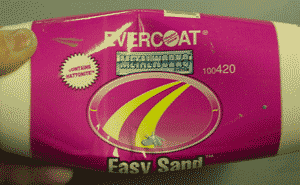
"Easy Sand" body filler from Evercoat and block-sanding
The filler I've used for this final work is "Easy Sand" by Evercoat. Bill McKenna mentions it on his '63 E-type FHC restoration website, and I found it at the local auto parts
and body shop supply. The chain automotive stores, around here at least, don't have it in stock. It is very good stuff. The filler comes in a tube-like bottle (see the picture), so
dispensing it is easy and creates no mess at all. Like other fillers, Easy Sand is a two-part product, so it should be durable. The filler itself is very fine and goes
on very smoothly — it's more a cream than a putty. The manufacturers say it bonds well to metal, plastic, and primers.
The best thing about it for this kind of work is that it sands so nicely. When I've used other filler to bring up low spots in primer coats, I've always doubted whether the
stuff would stick to primer, so I've ended up sanding right to the metal again. Also other fillers often sand badly when they are adjacent to buildable primer. The stuff
usually is slightly harder than the primer, and so you have to be careful about outlining your filled area with a low spot in the primer. (Good blocking usually makes this
less likely, though.) The Easy Sand product blocks very nicely.
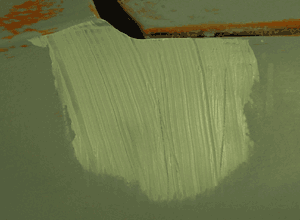
I mix the filler on cardboard from soft drink containers or cereal boxes. I also use the cardboard to create a straightedge filler "knife." These are probably not
professional grade tools to use, but they have the advantage of being easy to clean up — you just throw them away. The downside of the cardboard filler knife is that
it often doesn't apply the filler smoothly. The third picture from the top shows the freshly applied filler, and it does have some troughs.
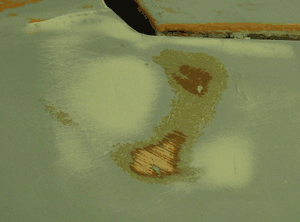
Block the area after the filler has cured. The area should be noticably better, though it might have a few imperfections. I noticed on this repair that I missed a small
tap dent that I created while tapping down one of the high spots. It was not a particularly big dent, so I figured that the buildable primer would take care of it You can see
the effect of the 60-grit sandpaper on the area. The two original high spots have merged to become one elongated spot, now flat from sanding. Flanking low spots have been
filled with the filler. There isn't very much filler left in the area, which is as it should be.
Repriming and blocking the repair
After the filler is blocked, it's time to reprime the area. I use a paint brush to apply the primer, and that works quite well in small areas like this. After the primer is
dry, block it again. This should bring the area to where you need it to be. I did this small repair after the second primer coat was blocked, and the problem was apparent.
(This door has been a real job, and this little fix was nothing compared to the rest of the smoothing that was required. The big work was the result of many minor ripples
all over the mid section of the door. That work was tedious mainly because getting the lines straight was complicated by the large surface area.)
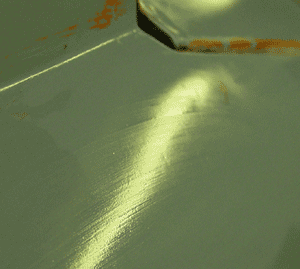
Any imperfections in the primed surface of the repair will get a at least one more going over before the surface is ready for color. I check the light line of the repaired
area to see where it needs more attention. As you can see in the bottom picture, it's in pretty decent shape, though it has some slight indentation yet. This will be taken
care of in the next round of primer coat and blocking.
There is no doubt that these small repairs and the multi-staged priming and blocking is a time consuming process. But it's also indispensible, unless you're willing to
settle for a less than acceptable finish.
|
|
|
|
|